Category Archives: Other

Do Less Alone.

Last year, I pledged to give up liking things ironically and to be more honest in most aspects of my life. It proved to be considerably easier than I expected, and was, if I’m being honest, a way to listen to Katy Perry without feeling too guilty. Pop culture resolutions are all well and good if they can expand beyond that, but the Queen Rule really didn’t.

I’m learning to like challenging myself more, so I thought of some accomplishments I could achieve:

Run a marathon? Sure!
Beat my time in the Around the Bay race? Sign me up!
Record my electro-folk solo project? Finally!, you likely exclaim.
Find my dream job? Why not?

But aside from being fitter and having more fans and money, and (perhaps) being happier, do these make me a better person even if I fail attempting them? Do they address anything that actually needs addressing?

One thing I’ve been noticing more and more lately is that I’ve come to enjoy the company of others more. That sounds strange, but I’m a very introverted person. I’ve often chosen to stay home when given the option of a social gathering, and still do so every now and then, but lately? I’m feeling that urge an awful lot less.

Maybe it’s some kind of lizard-brain response to my kid on the way. Instead of cramming as much alone time between now and June, my brain wants to get as used to constantly being around other humans as possible before I have no biological, ethical, or legal choice in the matter. But why not see how deep this rabbit hole goes?  What’s the worst that could happen?

So my resolution? Three simple words. Do Less Alone.

What does this mean for you, dear reader? Probably a few more text messages, a few more conversations over a pint/latte/waffle, and a few more invitations to be run buddies. They’re small things, sure, but there’s no escaping the fact that my life is going to change permanently very soon, and I doubt I’ll ever be more reliant on the wit and wisdom of other people.  Odds are, if you’re a parent, I have some questions for you.

So you can expect some changes to this blog, too. I’ll be shifting gears towards more entries about becoming (and being) a Dad because, quite frankly, it’s very easy to feel alone when you’re a man infanticipating. Hopefully, the frequency of posts will increase as well.

So here’s to 2013. The biggest adventure yet.

Unintentionally Athletic

Every now and then, someone comments on how I look.  Usually someone I haven’t seen in a little while.  Specifically, how there’s less of me to look at.  I guess it’s time to admit it: I’ve lost a bit of weight.

I have a hard time talking about it in too much detail for a lot of reasons.  For one thing, I still consider this whole fitness thing to be a work in progress.  But since I’m now past a year of running, and the comments haven’t seemed to stop yet, I think I should get my story straight.

If you’ve been among those who’ve asked me how much weight I’ve lost, you probably didn’t get a straight answer.  This is because when I was at my absolute heaviest, I had no idea how much I weighed.  I wasn’t getting regular check-ups with my family doctor, and I don’t think my parents have ever had a scale in the house.  So the heaviest I’ve actually recorded myself at was 218 pounds, in 2008.  Here’s a picture taken of me at around that time:

Me on Graduation Day, 2008

I’m not sure what my heaviest ever was, but I don’t think it’s much of a stretch to say I came close to 250 pounds at some point.  Those of you reading this who have known me longer than 10 years can probably vouch for this.

So for the sake of argument, the intentional and continued weight loss started in the summer of 2008, and my starting weight was 218 pounds.  The first big milestone was getting under 210.  Not because it was an enormous amount to lose, but because it made a big difference in my appearance.  Here’s me somewhere around that milestone, sticking it to the man on Halloween:

Only about 10 pounds less than above, but there’s obviously a bigger change between the two pictures than just a respectable haircut.  Fast-forward to around May of 2009.  I’d kept up with the gym, but by this point, the main office for the company I was working for had moved.  The new location was considerably farther away from Union Station in Toronto than the previous office.  This meant in addition to my (now somewhat dwindling) gym time, I was walking between 45 and 60 minutes to and from work.  After a few months of regular and lengthy walking, I broke the 200 pound plateau I’d been at since at least age 13.  It didn’t look or feel all that different from 210 pounds, but it presented a huge victory all the same.

I probably parked at a shade under 200 pounds for about a year, but for most of 2010, I was steadily becoming a little more fit.  Aside from the walking, I started running the Wentworth Stairs (500+ metal steps up the Niagara Escarpment) and doing the occasional four or five song jog at a track near my apartment.  It was around this time that I scheduled the first Physical of my adult life, along with bloodwork and all that good stuff.  According to my Doctor, I was 194 pounds with slightly elevated cholesterol and blood pressure.  I panicked.  I was nearly 26 years old, but those didn’t sound like 26 year-old conditions.  46, perhaps.  Nothing a bit of red wine and exercise couldn’t fix, he said.  The next day, I overdosed on the latter and gave myself a pretty nasty case of heatstroke for the weekend.

But I did start taking exercise more seriously at this point. I started experimenting a little bit more with different kinds of exercise after leaving my job in Toronto and going back to school.  I was within six months of getting married, and was determined to get my weight down to what I assumed to be a correct weight for my height: 180 pounds.

I tried rock climbing, tried to keep up with running (I usually did 4-5km a few times a week fairly late in the day), and spent a lot of time playing Wii Fit.  I’m not sure what my final weight was, but here’s what I looked like on the big day:

I’m the one on the right.

Within a few weeks of the honeymoon ending, I started running on the Rail Trail, a semi-paved trail between Hamilton and Brantford.  Alissa and I’s new home was within walking distance of it, and one night while watching a Hockey game, I decided I was going to go for a run.   As you may have noticed, it’s become a pretty big part of my life ever since.

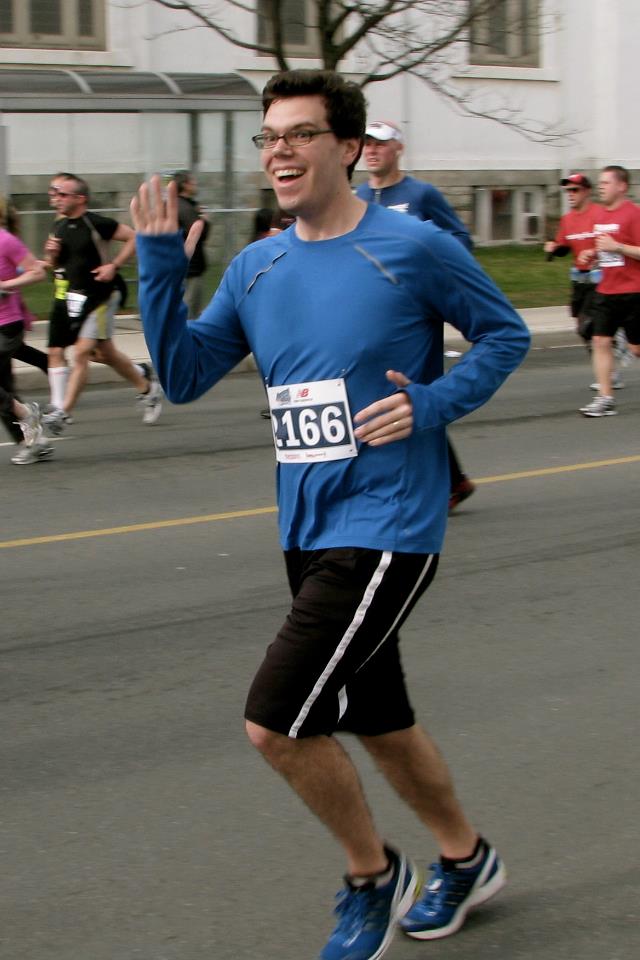
Since May-ish of 2011, I’ve logged somewhere north of 1,000km on the rail trail, roads, and a beach in the Dominican Republic.  I ran the Road2Hope Half-Marathon in 2:05, and the legendary Around The Bay 30km road race in 3:20.  At my last medically accurate weigh-in shortly after the half-marathon, I was 182 pounds.  At Around the Bay, I looked like this:

The smile didn’t last long.  I barely finished, and hobbled across the finish line with a strained IT band at a considerably slower pace than I was hoping for (my goal was to break 3 hours).

Like I said, it’s still a work in progress.  I have a few short-term goals in mind, like running a full marathon or a mini-triathlon.  Both of those, I hope to do before I turn 30 in the summer of 2014.  At the moment, I’m running a few times per week (usually around 20k total) and biking to and from my job in Burlington; about 20km each way.  I’m not sure what I weigh right now, but this is the most recent photo of me, taken at CBC Hamilton’s James Street offices:

Progress has clearly been made.

I’m not sure what the ultimate goal will be, but I do want to keep going.  I come from a family with a lot of Octogenarians, and my Nana just turned 90, so that provides a very distant motivation.  I don’t know if that’s enough, but for now?  It’ll do just fine.  And in the meantime, I can at least get around to replacing all those Extra-Large t-shirts with Mediums.

Running!

Since I started running (well, running seriously as a hobby rather than just a thing I do when I eat too much), I’ve noticed that a number of people in my social circles have either confided that they’ve been doing it for a while, or are interested in starting.  Since I have about a year under my belt, I’ve learned a few things (some the hard way).  Here’s some thoughts..

On shoes

Shoes matter.  A lot.  However, they don’t matter in a lot of the ways you might think.  If you want an impossibly in-depth look at running shoes, Runblogger.com has countless articles and reviews about running shoes and the science behind them.

Since I lack both any scientific knowledge and have only experimented with a handful of shoes, the best advice I can come up with is this:  Go to a running store and annoy the staff until you find a pair of shoes that makes you want to run more.  Cheaper shoes don’t last as long, but they’re not a recipe for disaster beyond that if they’re up to the task of running at all.

Most folks will recommend that you replace your shoes every 500-800km, since the cushioning eventually stops, er, cushioning.  This might mean you’re good for a few months or longer, but it does mean you’re spending a lot of money on shoes in the long run (no pun intended).  One tip I’ve heard a few times is to find a pair of shoes on clearance and buy multiple pairs of whatever you like best; roughly the same price as a brand-new pair, but you’re covered for a longer time.

In general, I feel pretty comfortable saying that shoes are the only piece of running gear that’s really worth putting a good deal of money into.  The wrong shoes can hurt you (even if it’s just blisters), and the right ones can motivate you to run more.

On clothing

Truth be told, you can run in anything you like.  However, clothes designed for running tend to be better at it, and will do wonderful things like wick away moisture and ventilate your torso.  So there are benefits to wearing the right kind of clothing, but you’re probably going to be okay running in whatever feels comfortable.  For me, it became pretty clear what didn’t work very fast.

On races

They’re fun!  Lots of fun!  And you get a free running shirt, which saves you the trouble of picking one out.

One thing I would definitely recommend is looking around for reviews of whatever race you plan on competing in.  Most people will tell you that Around The Bay is a very hard course, but not as many people will know that the Road2Hope Hamilton Marathon has long downhill passages and your run might be interrupted by a train.

Another cool thing some races have is a race expo, which is basically a giant running/fitness gear sale.  So if you’re looking for a deal on some gear, it can be a pretty good way to go.  It’s also a good way to find out about other races, and to swap stories with other runners.

Pros and Cons: Podcasts in the ESL Classroom

Periodically, I will be posting some thoughts on teaching English as a Second Language in an urban setting.  This is one of those posts

One of my favourite things for the last few years has been podcasts.  They’re free, they’re entertaining, and they empower creative people in a way few other mediums do.  And as luck would have it, plenty of radio stations have been using the medium as a way to distribute their programming.  Now I can listen to Vinyl Cafe whenever I want!

So I know podcasts are a fantastic resource for keeping me entertained.  How are they as a resource in the ESL classroom?

Pro: Any topic you want, there’s probably a podcast for that

Podcasting requires little more than an internet connection and a computer capable of recording audio files, so it stands to reason that anyone sufficiently passionate about something can release a podcast.  Hooray!  Knowledge for everyone!  Except…

Con: Any topic you want, there’s probably a podcast for that

That low bar of “internet access and a microphone” also means it’s difficult to determine which are actually useful, well-done and worth actually using in the classroom.  Sure, you can make some safe assumptions, like CBC and NPR podcasts having (if nothing else) standard English usage and clear diction, but barring a great deal of research, there’s still a lot of vetting to do.

Pro: They’re downloadable audio files, not physical media or live broadcast

This is probably the most significant pro in my mind.  Gone are the days of hearing something on the radio that is lost to eternity unless you were taping it.  Scratched CD’s and worn out cassette tapes are a thing of the past.  As long as you have an iPod and some speakers, you’re good to go.  Right?

Con: They’re downloadable files.

As easy to use as iTunes and an iPod can be, they’re still not without their issues.  I’ve had a few times where an iPhone sync just didn’t take.  No matter if you’re willing to use your iPhone on the fly and download over 3G, but a smartphone with a healthy data plan is a new and fairly costly resource for any teacher.  A new textbook per month would cost less, and those never get corrupted or not work properly.  There’s obviously a lot of ways around this, but not all are simple or straightforward.  This con depends a lot on the patience of the teacher.

Pro: They can become a classroom activity unto themselves

Remember that bar of a microphone and internet access?  That remarkably low qualification to be a podcaster?  If you’re reading this, you qualify.  If all parties are willing, your class can have their own podcast.  Maybe as a long-term independent writing and speaking assignment, maybe as simply a means of sharing classroom techniques with the world, maybe something else entirely, but this is a possibility worth exploring.

Consider the possibility of a year-end project consisting of a class of 12 immigrants telling the story of how they came to Canada or discussing their story of settlement and integration.  These kinds of projects have always been possible, but creating one for an enormous audience is relatively new.

All in all, having used podcasts in the classroom, I’m convinced that they’re a worthwhile resource.  Not the resource, but a resource that, with a few hours of vetting, can be a reliable and convenient classroom resource for listening activities.  And as an activity itself, it opens up a lot of new possibilities.

The Queen Rule

It’s not that I don’t like irony.  In fact, my favourite t-shirt proclaims the exact opposite (although it’s my favourite because it’s remarkably comfortable after all these years).  And I defy you to name a more satisfying literary device than Dramatic Irony.  You can’t.  And you can still be as ironic as you wish.  I, however, am formally retiring from irony in 2012.

In an effort to have a more sincere and authentic 2012, I’ll no longer be devoting any more energy to liking things ironically.  Or “despite it’s flaws”.  Or “for the genre”.  If I like something, it will be unqualified.  Is this because life’s too short for joy to be constrained?  Because labels devalue what we hold dear?  No.  It’s because I like Queen, always have, and never with a trace of irony.  And because I’ve spent too much time living by my own made up rules.

Queen being, of course, the band that wrote a rock anthem with the complexity of classical music, and wrote it about riding bikes.  They also wrote the theme song to the remarkably silly Flash Gordon movie from 1980.  And the bombastic theme song to The Highlander (because there could be only one).  In general, Queen’s appeal has a lot to do with how earnestly and ambitiously they crafted songs with objectively ridiculous lyrics and subjects.

So logically, if I can love Queen without irony and without qualification, what can’t I love without irony?  Savage Garden’s I Want You?  Lady Gaga?  Meat Loaf?  That Justin Bieber song I secretly hum all the time?  They’re all on the table.  So is the Spider-Man cartoon from the 90′s and any and every Chris Farley movie.

Maybe life isn’t too short, and it’s actually too long.  Maybe I’ll live past 100 years and be able to devote an entire decade to re-writing Dickens in Klingon.  But I’m coming to realize that sincerity is in short supply, and as long as I’m on this planet, it’s not a bad idea to try and add a little more.

So that’s my 2012 resolution in a nutshell: live by the Queen Rule.

role model

I’m pretty nerdy. I play old video games, love sci-fi and spy movies, and spend a good deal of time online. I’ve read more than half of Shakespeare’s plays and have a 67% winning percentage at Pub Quiz night. I will happily argue about why Batman is the best superhero, despite his lack of powers.

So when a friend of mine told me that I was an inspiration to him for being who I am and getting married all the same, I was somewhat taken aback. Not because of any humility or my tendency for self-deprecation, but simply because it never occurred to me that I was living in a way that was inspiring. Sure, I’ve taken steps to find a career that is about more than just a way to make money, and I’ve been successful at the Hamilton Fringe Festival, but I never thought I was already there.

I mulled it over for a while, and came to the following conclusions:

1. Nobody chooses to be a role model. It’s something that just happens. Obviously, this has implications for how I live. I can’t act like nobody’s watching or that nobody cares what I do after I’ve had someone tell me that they are and they do.

2. You’re probably already a role model to someone. I never considered that I might be until someone told me I was. Chances are, you don’t either. Which brings me to point number three…

3. It’d be nice if you told the people you look up to that you look up to them. If you haven’t already, anyway. It might inflate their ego, but it might convince them to keep on keeping on. Who knows how many people are on the verge of giving up on doing good because they can’t see the difference they make. I’m generally a fan of people who do good, and I think it’s in everyone’s best interest to encourage people to be better.

The last year has been one of many changes in my life, and the blog is changing with it.  While I won’t promise regular updates since my track record for that is pretty lousy, I hope that my adventures in the unintentional are worth reading about all the same.

Review: Lost In La Mancha

Behind the scenes stories have always fascinated me. Even since before
my time in theatre, I’ve been asking myself some kind of variant of
“how did they do that?” ever since the day I saw Star Wars in 1997.
After a few shots at directing myself (I’ve made three short films and
one 90-minute student film in addition to directing four plays), I’m
more curious about how close to off the rails things can ever get
before disaster.  Lost in La Mancha provides that answer for me and,
painfully, Terry Gilliam.

When Gilliam’s The Man Who Killed Don Quixote fell apart before
completion, there were camcorders to capture it all. Lost in La Mancha
is the closest thing to a proper movie that will come from that
ill-fated shoot. It starts with unprepared actors and jets flying
overhead and it all goes downhill from there. And that’s after only
barely getting financing that left no room for error.

Seeing Gilliam’s dream torn away from him in both fascinating and
heartbreaking. The film never shows him at the depths of despair, but
remembering how long it’s been since he was last shown giggling out of
joy that something is going exactly right fills that in for us.  It’s
certainly a biased documentary, but how Gilliam could come out
anything but tragic given his circumstances is difficult to imagine.

Documentaries can be hard to rate effectively, but I was engrossed and
heartbroken for much of the film. Gilliam sometimes is shown as an
example of how not to Direct, but the scenes of the man beaming with
joy at seeing just the camcorder footage of his giants suggest
otherwise. Passion is what makes great art, after all.  Lost in La
Mancha
isn’t great art, at least not in the same way as some of
Gilliam’s best work, but it is a stirring look at the insanity of
following one’s passion.

B+

Review: Inception

Christopher Nolan seems to be a fascinated filmmaker.  Fascinating, too, but he absolutely has some key themes and ideas that he wants to explore in his films.  The most prominent, at least at this point in his career, seems to be order.  The notion that people can impose order on their world figures strongly in Memento, The Prestige and The Dark Knight as subtextual themes, but it’s essentially the text of Inception.  Perhaps not the result of applying order to chaos, but of applying the logic of design to the inherent illogical state of dreaming.

Inception is, fundamentally, a heist film with a strong emotional core.  The layers that Nolan adds are in many ways literal layers, and it’s to his credit as a writer that the film never becomes so obsessed with the gee-whiz novelty of it’s concept that it gets in the way of telling that story.  Yes, confusion can set in, but for a movie that takes place largely within the subconscious, it’s layered in about as straight-forward and logical a way as possible.

Does this make sense?  It seems like a paradox for a dream to be easily understood, navigated and even manipulated.  Yet these aren’t random subconscious dreams; they’re painstakingly designed.  By an architect, no less.

Still, even in a logically structured dream, the chaos of the subconscious can’t be controlled.  Leonardo DiCaprio’s Cobb appears to be intent on preventing that, much like Leonard in Memento or Bruce Wayne in The Dark Knight, but it appears as though Nolan doesn’t think order can be imposed where it isn’t already present.

Story aside, however, Inception is engrossing and astounding.  The cinematography is absolutely beautiful, taking pleanty of time with it’s shots; when they’re composed with such detail and purpose, there’s no sense at all in quick-cut editing.  The action scenes are unlike anything seen since The Matrix, and the visual effects are state-of-the-art.  It’s difficult to really overstate how great Inception looks.  It was shot and edited with purpose, and holds your attention like few films can.

But all that aside, Inception does need to be more than just an intriguing story and spectacular visuals.  In science fiction, your concept is only as good as the characters who have to navigate it; at the end of the day, the audience needs a reason to give a shit about what happens.

Performances are, in general, solid.  There’s really no glaring errors in casting or performances, save some occasional overacting by Ken Watanabe and perhaps too much exposition required by Ellen Page.  But the core of the story, Leonardo DiCaprio and Marion Cotillard, excels.  Both deliver stirring performances, and give the film the weight it needs.

So with all this working for it, what more can be said about Inception?  It’s a rare film; one that looks like it cost the $200 million that Nolan required to see his vision come to life.  It’s surprisingly ambitious, and surprisingly ambiguous.  There’s a lot for the audience to wrestle with, and it practically demands repeat viewings.

Review: The Lookout

The Lookout – 2007 (Dir. Scott Frank)

The Lookout is an easy movie to really like, but not quite love. For one thing, it’s a really smart film; no, it’s not really breaking any ground in it’s story (it’s about a bank robbery in a small town), but how it tells the story is very sharp. It also boasts some great performances by Joseph Gordon-Levitt and Jeff Daniels. Having a solid script, nice visuals and great actors is one thing; but making them all elevate the material is another. And that’s where the intelligence of the film comes into play.

Joseph Gordon-Levitt’s character is disabled. Gordon-Levitt’s character suffers from brain damage caused by a car accident in the years before the action of the film; he has amnesia. In the hands of a less tactful writer and director, this could be a recipe for disaster. In the hands of a less capable actor, too, this could come across as embarrassingly patronizing. Instead, it serves to make the film better. Gordon-Levitt’s performance is sympathetic, but never pathetic. The audience feels his frustration, but he’s never given a free ride because of his handicap. If anything, his disability makes the film’s antagonist (Watchmen‘s Matthew Goode) seem more cruel, rather than Gordon-Levitt more innocent.

The film also takes it’s time, and allows us to get to know the characters. Scenes run, if anything, a little too long, rather than a little too short. The film feels longer than it’s 99-minute runtime, but that’s an asset more than a burden. The camera isn’t afraid to linger on a shot. Bu it’s the strength of the acting, even smaller parts, that does the heavy lifting here. Gordon-Levitt, Daniels and Goode all turn in stellar performances. Deputy Ted doesn’t have much screen time, but Sergio Di Zio turns makes them work. Likewise, Greg Dunham’s brief performance as Bone is menacing without being over the top.

The Lookout, the first feature written and directed by Scott Frank, does wear it’s influences on it’s sleeve. The snowy small town setting and menacing henchman recall elements of Fargo, and the amnesia angle reminded me of Memento, but the film stands on it’s own merit. And frankly, if you’re going to borrow liberally from anyone, it may as well be Christopher Nolan and the Coen Brothers. Regardless, it’s a very strong film and a worthy entry in the canon of contemporary crime films.

B+

Review: A Serious Man

Originally printed in Mayday Magazine, March 2010

Before I review A Serious Man, I feel that I should disclose two important personal facts.  The first is that I’m a huge fan of the Coen brothers.  That’s not too extraordinary; it’s hard not to at least respect the Coens for the quality and originality of the bulk of their work. I’ve encountered few people who don’t love at least one of their films.  I’d certainly argue they’ve made no less than three modern classics (Fargo, The Big Lebowski and No Country for Old Men), and even if they haven’t, their reputation is, at least in my opinion, deserved.

The second is that I’m not Jewish and have had very little interactions with Jewish culture. And while seeing A Serious Man may not necessarily require a working knowledge of contemporary Jewish culture, it certainly helps if you do.

A Serious Man is a dark comedy about the existential crisis of Professor Larry Gopnik (he is played by Michael Stuhlbarg, a veteran stage actor making his first major onscreen appearance).  Larry’s wife wants to leave him.  His son has started smoking pot.  His daughter is apathetic towards him at best.  He’s facing a serious moral dilemma at work.  When he seeks religious guidance, he winds up with less comfort than he started with.  All in all, the early 1970′s are a pretty bad time to be Larry.

And that’s really just the tip of the iceberg.  The film piles on misery after misery in what should be one of the best weeks of Larry’s life; his son is about to have his Bar Mitzvah and Larry appears to be in good position to gain tenure at his university.  From there, however, a number of mild inconveniences escalate and escalate.  Some of this might be Larry’s fault, but we’re never given quite enough information to know for sure.

Is a rebellious child the fault of a parent? Is divorce the fault of an emotionally absentee partner? A Serious Man doesn’t show enough for the viewer to move beyond basic assumptions. Then there are events where Larry could not possibly be at fault; these, too, add to his plight.  Larry just has a lot of terrible things happen to him with no particular explanation why.

This is a common theme in the Coen’s work, but it’s presented differently here.  In their most beloved film, The Big Lebowski, few pleasant things happen to The Dude; yet this never seems too apparent because The Dude and his friends are engaging and likeable characters and the film leans quite heavily on the ridiculous.

While objectively A Serious Man never really stretches plausibility, only a few characters seem truly amiable.  Larry, though certainly not a cruel man, is a far cry from the likeable everyman.  He has a few scenes where he’s a doormat to a frustrating degree.  Still, I found myself growing sympathetic toward his fruitless search and ever-growing list of questions without answers.

That said, I don’t think the film blindsides it’s audience with misery. When you know what sort of darkness to expect, it comes as less of a surprise.  I wasn’t taken aback by the degree of suffering Larry endured during the film. At the same time, I was taken aback by the overall tone of the film: A Serious Man never revels in Larry’s pain, it simply presents it.  While the Coen brothers have made films that make a few laughs at the expense of it’s characters, I don’t think A Serious Man is one of them.

Ultimately, the Coen brothers have constructed a well-made film. They know their craft, and their writing is generally very sharp and the film is technically very good; they know how to get great performances out of their actors and the film is well-shot and well edited.  In particular, the film boasts a very strong performance by Michael Stuhlbarg, who to my surprise actually did not earn a Best Actor nomination for his work.

The question with A Serious Man isn’t “is this good?”, but “is this worth seeing?”  That’s a vital distinction to make, and I’m actually not sure what side of the fence I fall on.  Philosophically, there’s a fair bit to grapple with.  The film’s central question is “why do bad things happen to good people?” and the film never really tries to answer the question.  Or rather, if they do, they give such vague responses as “it’s all about perspective” or “just because, and who are we to question it?”.

Perhaps the journey the viewer takes is meant to mirror Larry’s, but ultimately, it’s a film that’s easy to admire but hard to love.

B